Shapewear in New Zealand: how to choose it, and why most of it fails
Sarah Stoute's team fits and alters more than 400 gowns a year. That means several hundred times a year, someone stands in a fitting room in shapewear that is not working — and we get to see exactly why. This guide is what we have learned, written for anyone buying shapewear in New Zealand, whatever they plan to wear it under. If you are choosing for a wedding dress specifically, the bridal shapewear guide works through it silhouette by silhouette.
Written by Sarah Stoute, couture bridal designer — 400+ gowns fitted and altered a year in Christchurch.
What shapewear is actually doing
It helps to be precise about the mechanism, because most disappointment with shapewear comes from expecting the wrong thing. Shapewear does not reduce volume. It redistributes it — applying pressure across an area so that the surface above reads as a smoother, more continuous line.
That has a direct consequence: whatever is compressed has to go somewhere. Compress the waist hard enough and your body will move towards the ribs or down over your hips. This is the single most common failure we see in fittings, and it is nearly always caused by sizing down further than the dress actually calls for. The garment is doing exactly what it was designed to do; there is simply nowhere for the displaced volume to go.
The better goal is a continuous line rather than maximum compression. A garment that holds moderately across a long span will almost always look smoother under clothing than one that grips hard across a short one.
The three ways shapewear fails
In the fitting room, essentially every complaint reduces to one of three problems.
Visible seams. Thick, stitched seams and folded hems press through lightweight fabric. Under silk satin, crepe or fine georgette, a hemmed leg opening is thicker than the fabric around it and telegraphs a horizontal line straight through. This is a construction problem, not a fit problem — no amount of sizing up will fix a hemmed edge.
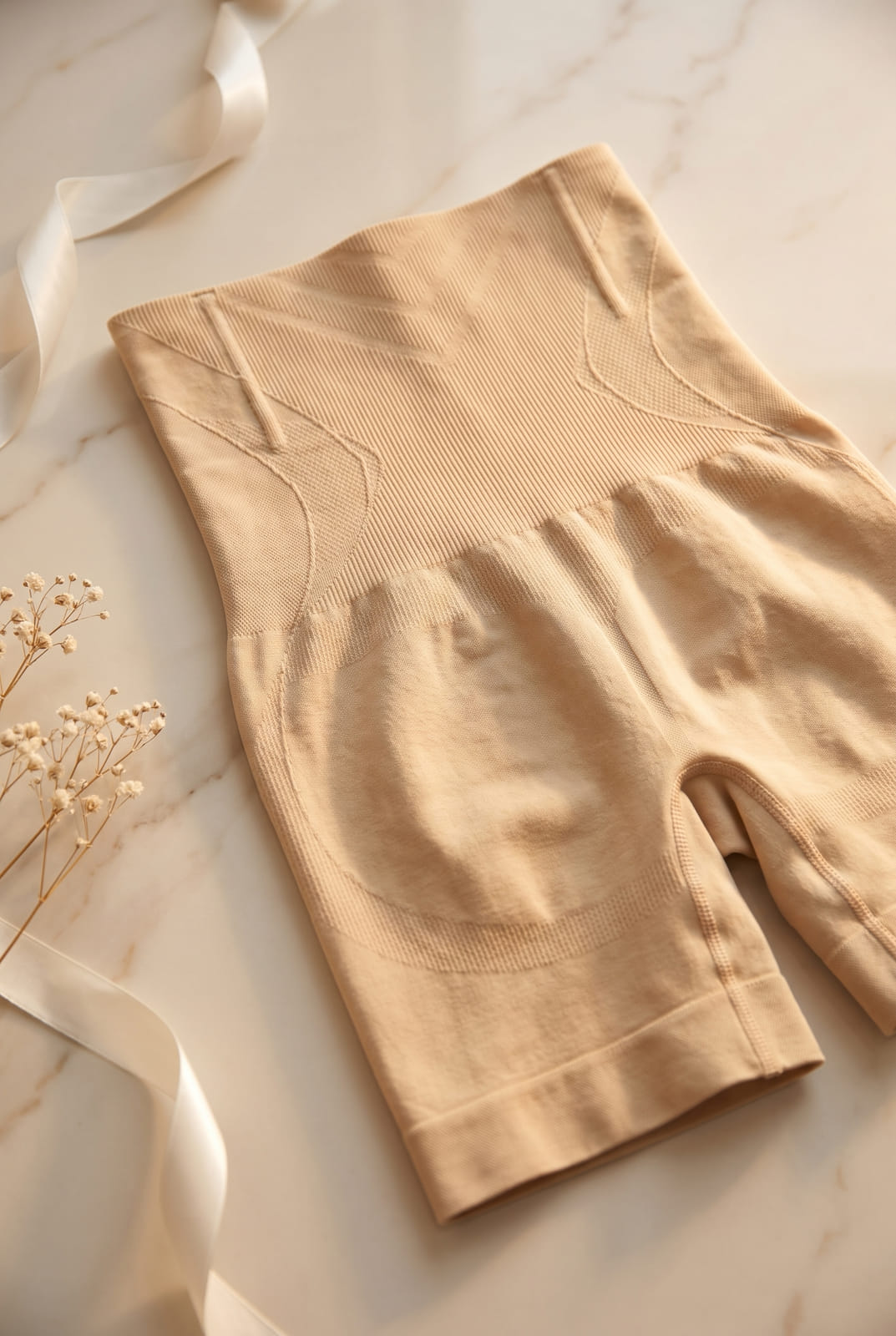
Slippage and rolling. A waistband with no anchoring will migrate down over a day of sitting, standing and moving, and once it starts to roll it forms a band that is more visible than no shapewear at all. Silicone grip strips at the top hem solve this by anchoring the garment to the ribcage rather than relying on tension alone. Silicone strips at the in-leg also help to stop the garment from rolling. A huge difference in our shapewear is the inclusion of boning to keep the shapewear elongated.
Compression pain. Heavy panelling restricts breathing and posture. Over a twelve-hour day this stops being a comfort issue and becomes a wearability issue — people take the garment off partway through the evening, which rather defeats the purpose.
The three levels of control, and when to use each
Shapewear is best understood by what it is trying to achieve rather than by garment name. There are broadly three levels, and matching the level to the outfit matters more than buying the firmest thing available.
| Level | What it does | Best under | Our piece |
|---|---|---|---|
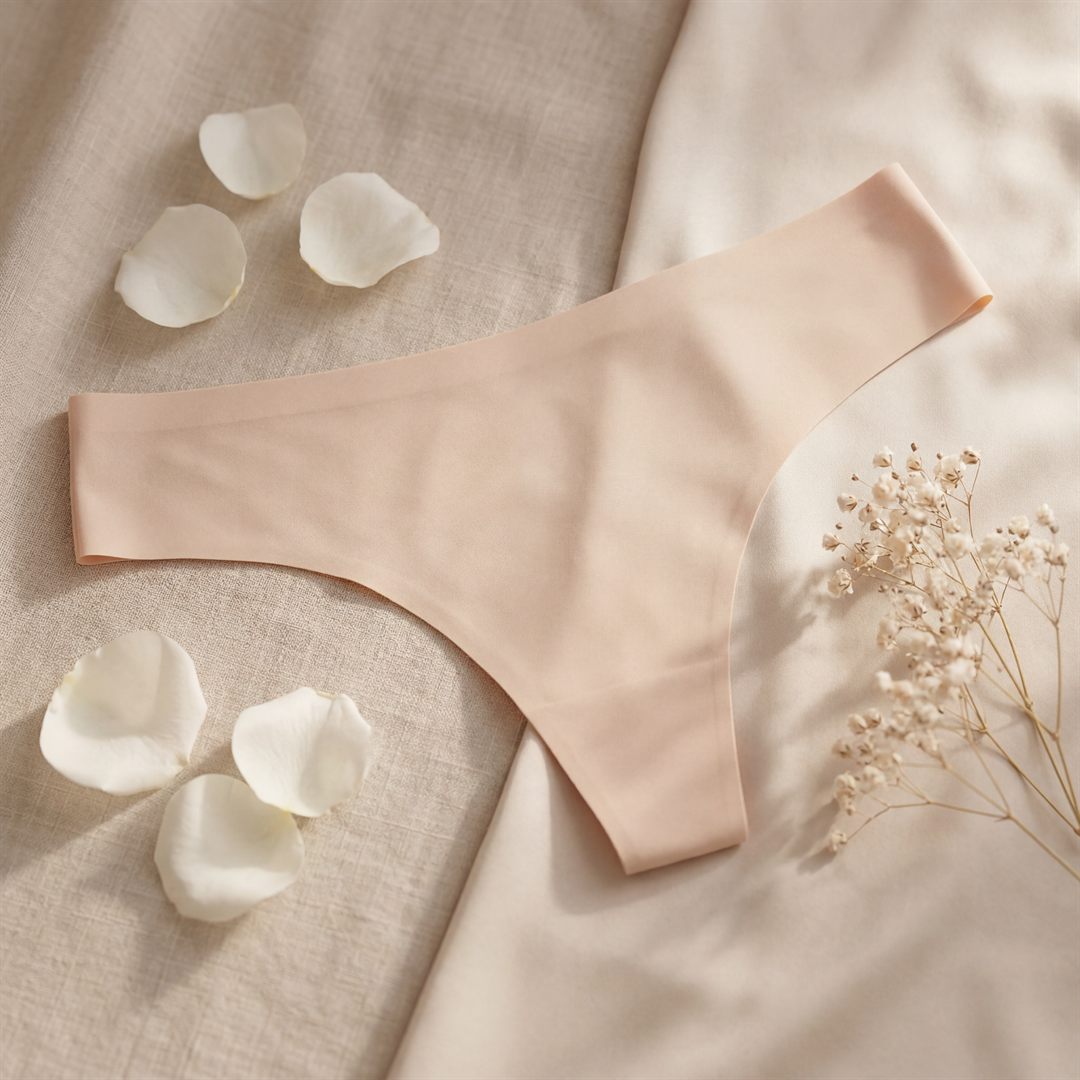
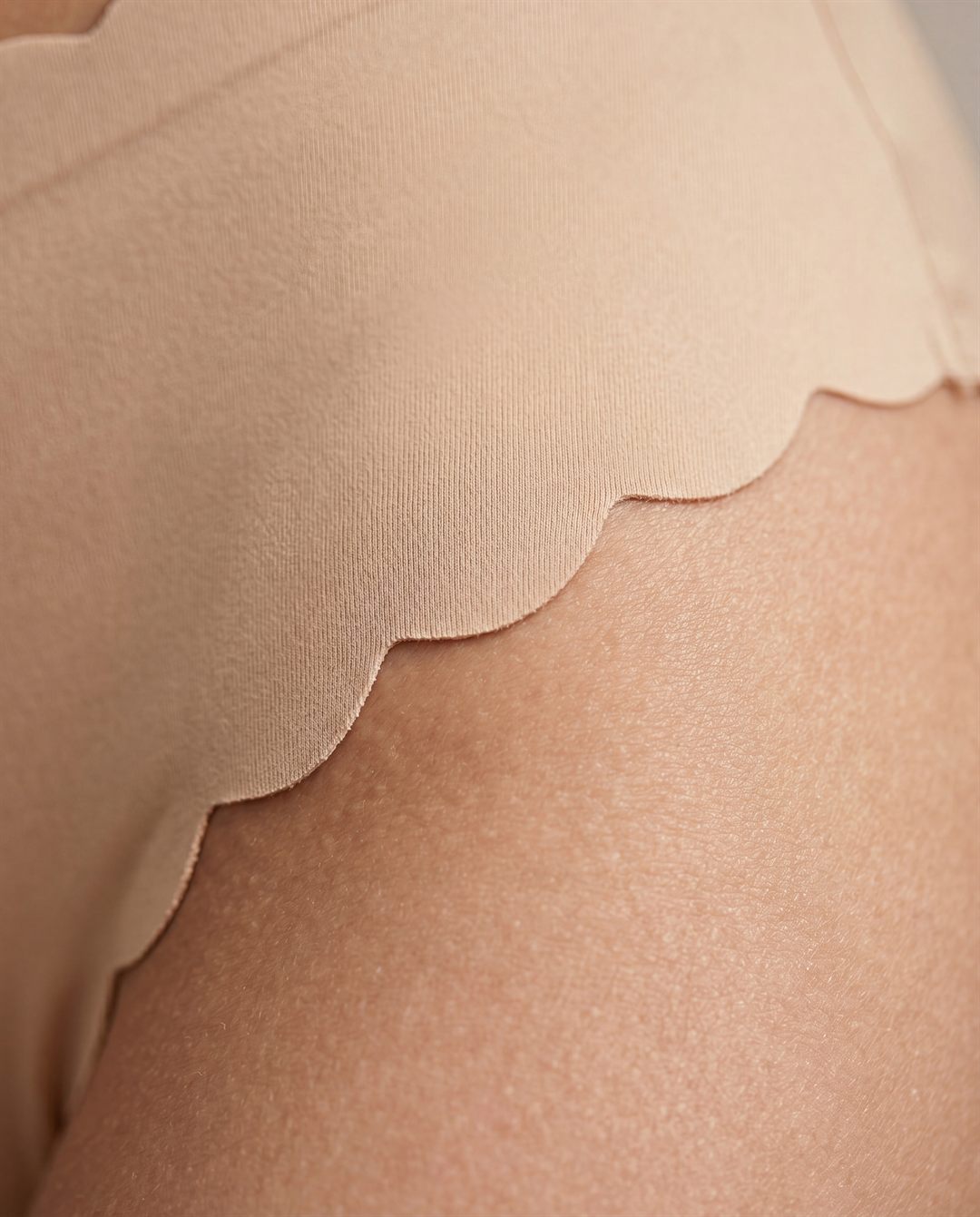
| Smoothing | Creates a clean surface with little or no compression | Fluid, clingy fabrics — crepe, georgette, bias-cut silk, jersey | Seamless Panties, Seamless Scallop Panties |
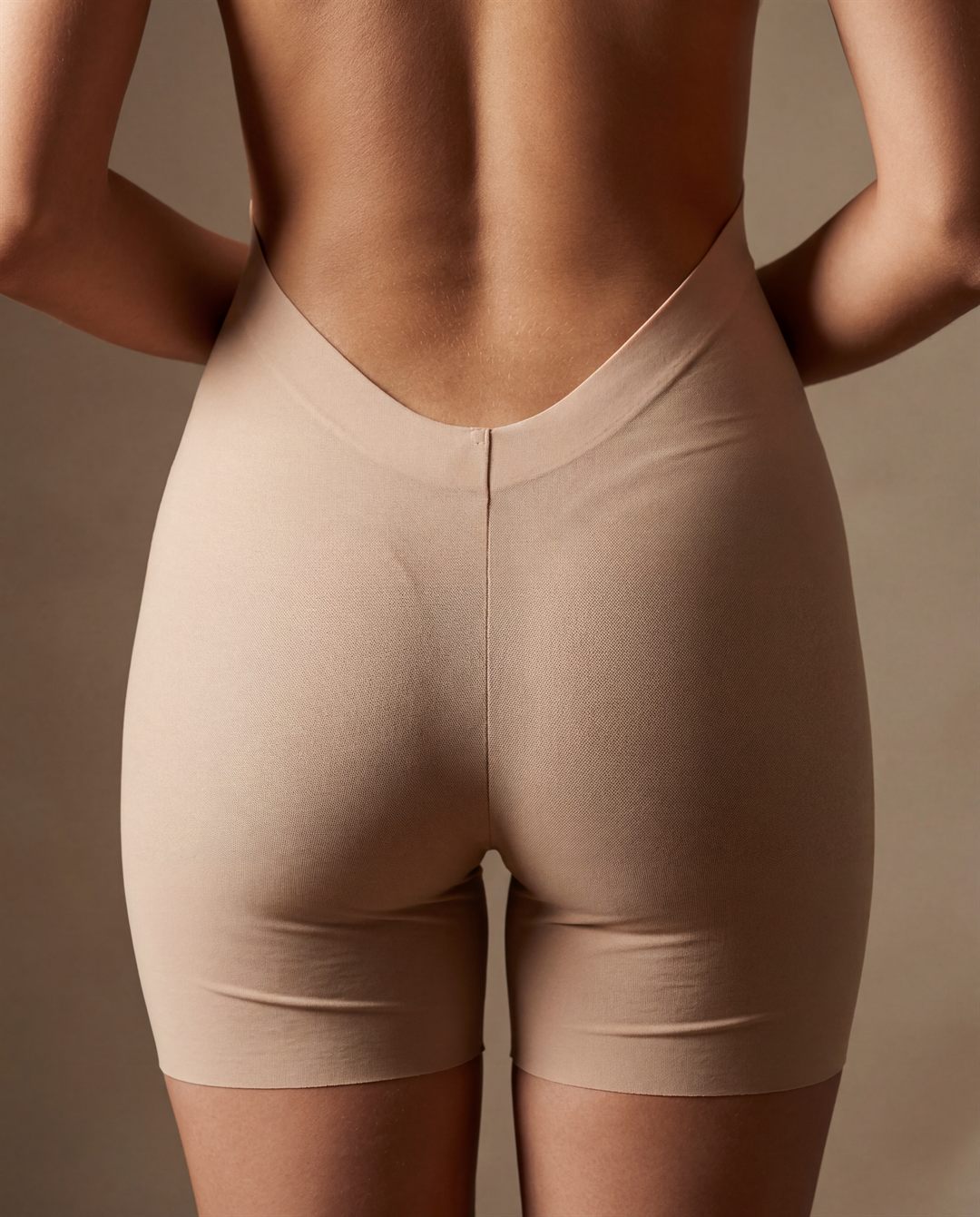
| Sculpting | Firm, continuous shaping across the waist, stomach and hips | Structured garments — Mikado, duchess satin, tailoring and full skirts | High Waist Shapewear Short, Low Back Shapewear |
| Contouring | Lift and shape for the bust, with no bands or straps | Strapless, backless and plunging necklines | Adhesive Bra, Pushies, Boob Tape |
Construction: why seamless is not a marketing word
There is a real, physical difference between garments described as seamless, and it is worth knowing which you are buying.
Traditional construction cuts panels and stitches them together. The seams are load-bearing and structural, and every one of them is a potential line under close-fitting fabric.
Bonded construction joins panels with adhesive or heat rather than thread. Flatter than stitching, but there is still a join, and under the most unforgiving fabrics a bonded seam can still catch the light.
Circular-knit seamless with a laser-cut edge is the flattest option available. The body of the garment is knitted as a single tube, so there are no side seams at all, and the edges are cut and heat-sealed rather than folded and hemmed. The fabric simply stops. There is nothing thicker than the garment itself anywhere on it, which is why this construction is the only one we use for anything worn under fine fabric.
A useful test when shopping: run a thumb and finger along the leg opening. If you can feel a ridge, so will everyone looking at the garment over the top of it.
How to size shapewear
Our sizing follows regular NZ sizing — S, M, L and XL. Size on your natural waist measurement, taken at the narrowest point of the torso, over bare skin and without pulling the tape tight. Not your dress size, not your jeans size — both vary far too much between brands to be useful.
Then think about the dress going over the top, because that is what decides the call if you fall between two sizes. If you do not want any bulging or pulling showing through the fabric, size up. If you want cinch and structure — a defined waist under a structured bodice — size down, knowing that the firmer the garment the more the compressed volume has to travel somewhere.
What we would not do is size down further than that in pursuit of maximum control. Past a point a smaller garment stops producing more shaping and starts producing more displacement, more rolling and considerably more discomfort.
Matching shapewear to fabric
This is the part most guides skip, and it is the part that actually determines whether anything shows. The fabric worn over the top dictates what can be worn underneath.
The general rule: the more fluid and reflective the fabric, the less you should be wearing under it and the flatter it needs to be. Heavy, structured fabrics are self-supporting and hide almost anything; lightweight fluid ones hide almost nothing.
| Fabric | Transparency risk | What to wear underneath |
|---|---|---|
| Silk satin, bias-cut | Extreme — shows every ridge and crease | Ultra-thin seamless with laser-cut edges, or adhesive tape only |
| Crepe, silk or poly | High — telegraphs texture and seams | Raw-edge microfibre, completely seamless, no hardware |
| Chiffon and organza | Medium — under-layers shadow through | Plain nude briefs with no lace, hardware or contrast waistband |
| Chantilly lace | Low to medium, depending on lining | Moderate smoothing briefs; push-up cups if strapless |
| Mikado and duchess satin | Low — opaque and self-supporting | High-compression waist shaping; the fabric will hide it |
Where we come from
FOUNDATION is the shapewear arm of Sarah Stoute Bespoke, a couture bridal house in Christchurch. The pieces exist because Sarah spent years watching brides struggle in shapewear bought off a shelf and designed for an average body under an average dress, and eventually decided it was easier to draft the garments properly than to keep working around them.
Everything we make was cut against real fabrics on real bodies in real fittings — which is a slower and considerably less scalable way to design shapewear, and the reason there are ten products rather than a hundred. The bridal origin is why the tolerances are tight. It is not a restriction on who the garments are for.